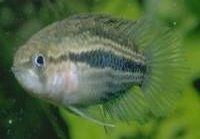
The following
article is based purely upon my observations, as I have been unable to find any
significant information with regard to these fish.
The Fish
Nannacara
Taenia originate from Brazil near Belém, they are much smaller than the other
Nannacara species, reaching a total length of about 4cm. Although not the brightest
coloured fish in their family they are an interesting and challenging dwarf cichlid.
Breeding Tank
A 24x12x12 tank is sufficient for two pairs, substrate
is not essential for these fish as they don't dig whilst breeding. I use a layer
of sand and gravel mix about a cm deep. Being cave spawners they will obviously
require some form of cave, upturned flowerpots or coconut shells are ideal but
don't make the entrances too big otherwise they won't use them. (The smaller the
better, you'll be surprised how small a gap they can squeeze into) Plants are
not essential but they do seem to prefer a partially planted tank to a bare one,
I use the plastic variety purely for hygiene purposes but any living plants will
do.
Conditioning
Nannacara Taenia are a greedy species
and readily accept flake foods as well as frozen. I condition mine on bloodworm
and daphnia when available (the frozen alternatives are just as good).
Breeding
To breed these fish place them in your prepared tank
with the following water parameters: -
Hardness 5dH< (mine bred
at 4)
pH 7< (mine bred at 6.5)
Condition them in the
breeding tank, as they seem to lose interest if moved from one tank to another.
When the fish are ready they will start to display to each other in front of their
chosen caves. This involves swiping at each other with their tails and shuddering
at each other whilst lying on their sides. The male is the smaller of the pair
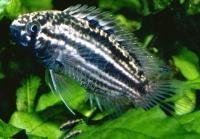
and is not as deep bodied as the female. He has light brown stripes running the
length of his body, and when displaying his cheeks blacken up and the stripes
become much bolder. The female (pictured at the top of the page) has similar brown
bands along her flanks but she has a darker almost black stripe running alongside
these. You will know immediately when some eggs have been laid as the female takes
on a dramatic colour change she almost looks like a different fish! Approximately
30 eggs were laid in the spawnings that I have had; these were tiny yellow eggs.
As the eggs develop they change to dark brown in colour, when they reach this
stage they are almost ready to hatch. The eggs take 2-3 days to hatch and the
fry are free swimming about 3 days after that. The fry are jet black in colour
at first but start to develop a light stripe along their bodies as they develop.
The fry will scavenge for food along the bottom of the tank under the watchful
eye of their mother (the male doesn't seem to have a role in their upbringing).
I feed my fry on powdered fry foods to start with and then advance them onto crushed
flake as soon as possible. Any small live foods are eagerly devoured after only
a couple of weeks. The fry are quite fast growing and after about 9-10 weeks the
mother leaves them to their own devices after looking after them constantly for
this time.
An example of a typical breeding
9/9/01
2 pairs placed in breeding tank and conditioned
14/9/01 Displaying
activity becomes much more purposeful
19/9/01 One female has changed
colour and on inspection a batch of eggs are found
23/9/01 Approximately
20 free-swimming fry emerge from spawning cave
1/10/01 Small bloodworms
taken by fry for the first time
5/12/01 Mother abandons fry, 16
in total remain.
You may have difficulty finding this fish in the
shops, in fact I have yet to see it for sale anywhere (I obtained mine from a
fellow breeder) but if you do manage to find them I would recommend them to anyone
who enjoys dwarf cichlids.