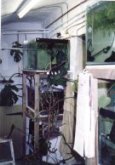
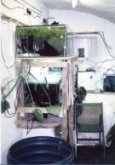
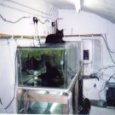
It
all started with a lecture Ken gave to our society last summer, about how he built
his fish house. At this time I had an ever growing mix of tanks in a small room,
once described as a study - then a hot and humid place with no room to move, peeling
paint, mildew and wires everywhere. I knew it would have to change but the only
place I could use for a fish house was the, half underground, cellar - but thee
cat door was down there and nowhere else to put it. "So what" someone
said and the idea grew. First the cats - a thick
heavy curtain for a door would keep the heat in but allow the cats to push through
- one old pair of curtains sewn together with a wool blanket in the middle. Then
the room - full of junk and tools - first I had to clear the outside shed to move
the tools out, then the garage to move the wood out, then ……. etc..
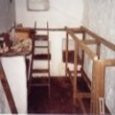
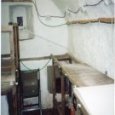
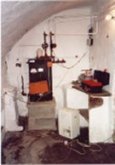
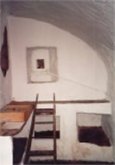
A lot of junk got thrown away. Most of the old plaster fell or was scraped off
the wall, then it had 2 coats of sealer (PVC glue and water) and 2 coats of brilliant
white emulsion (reflect the light). The floor is asphalt and I always intended
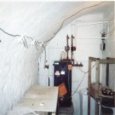
to carpet it, but I spill too much water. Insulation
- well the house is nearly 400 years old and the walls are about 30" thick
so that was a good start, topped off with a layer of polystyrene (swapped for
fish) jammed around and behind the tanks. Tank stands
- after much debate, wine and sandwiches, and despite the late arrival of the
instigator (Ken), a plan was drawn up and decision made to scrap my metal stands
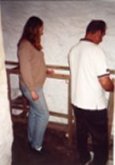
and kit the whole room out in made to measure wood stands. Using mainly 2"
x 2" tanalised timber with 3" x 2" for the 2 planned 5' tanks (the
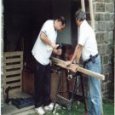
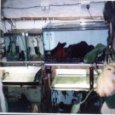
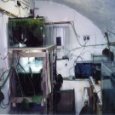
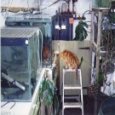
severums were growing). Ken and Arthur gave up many hours (see photos) to build
these, which, despite great plans, ended up made up as they went along to fit
the idiosyncrasies of an old building - the 5' tanks ended up 4' 9¾"! Electrics
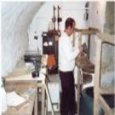
- Ken installed at least a million double sockets all round the room but I still
run out - you just can never have enough sockets. Light comes from fluorescent
tubes on the ceiling and 2 traditional tubes and starters over lower tanks. Plumbing
- we thought we found a cold water inlet and ran a tap off this for a water barrel
to store new water for changes just outside the door. It is fitted with a heaterstat
and is continually turned over by a small pump. Heating
- the boiler was already down there so I had a head start. Traditional heaterstats
were used in about ¾ of the tanks because I already had them. Room temperature
is consistently 78C through this winter, so this seems to be sufficient although
water temperature does vary around the room. The exception is when there is a
gale from the west which blows the cat flap open and it plummets to 60C - the
solution was a roofed cat flap with an angled tunnel entrance, and a small fan
heater on a thermostat in the room. Tanks - rather like
a jigsaw without the picture - trying to fit in the ones I had according to the
varying widths of the stands , then having, just a few, more made, including my
two 5'(ish) ones. Planing the logistics of moving loads of tanks, already full
of fish, in the correct order to give everyone a bigger tank, with the right filter,
some of their own water and a heater gave me a headache. All tanks were numbered
and labeled, the labels also showing the size and capacity, which is handy for
treatments. Half way through the Bolivian Rams spawned and the whole scheme was
thrown out! It is surprising how long it takes just to physically move and fill
tanks, fish, and filters (why does it always take ages to restart external filters?)
and how tired you are at the end of it. Maintenance
- once the tanks were in place I ran tubing round the walls and dropped valved
connections down to each tank. Water is then pumped out of the storage barrel
round the loop, and I just open the valves for the tanks I need to top up. To
empty the higher tanks I have a similar lower loop with valved connections down
to this from each tank, once full of water gravity does the rest. The loop ends
in a second barrel where I have a pump connected to a hosepipe that goes out the
cat flap! Floor level tanks are emptied with a small pump attached to a hosepipe
into the waste barrel. All this took the rest of the
summer and autumn and the fish moved in in November. It went quite well but not
without some problems - all of them wet. The water maintenance system was very
slow, unreliable and prone to leaks. Initially I had used 9mm aquarium tubing
for the loops with standard 6mm airline and airline valves into the tanks. The
airline valves were not up to the job and reduced the flow to a leaky trickle.
I have since replaced this with horticultural irrigation 9mm valves and 9mm tubing
into the tanks, much cheaper and it works much better - but watch out for fry
being blasted round the tank! A more serious problem was the incoming water from
the mains - a visiting plumber pointed out that the connection came from the return
on the radiator circuit. This probably explained why nothing had spawned in the
first 3 months and I was lucky nothing had died. Within 2 weeks of changing the
connection they were all at it down there! Even the discus started again after
2 years off. My final water problem no one can help me with - I keep forgetting
I've left the tap on and flooding the place! So today
I have a study again and an easy to maintain fish house full of happy cichlids,
catfish, Siamese fighters and CATS - they love it - reclining in the warmth on
the glass lids, under the sun lamps, sampling the flake food, always a drink handy.
Obviously I did it just for them. |