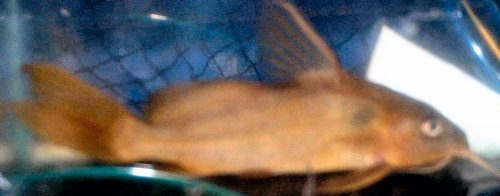
| Synodontis bastiani Scientific
name - Synodontis bastiani. In textbooks you are more likely to find this fish
under its junior synonym name of Synodontis euberneensis. Common name -
Ivory Synodontis. Natural distribution - Ghana and the Ivory Coast. Size
- 20cm. Body characteristics - The background colour of juveniles varies
greatly from an ivory colour to plain brown to lime green. Some populations have
a foreground of light spots. As maturity is reached the body sports a beautiful
rich golden colour with the thick edges of the pectoral fins and dorsal fin a
deep yellow.
The gills are frilled and to the left of this area is a large
dark spot. The adipose fin is extremely thick. In juveniles the first ray of the
dorsal stands erect like a blade but this distinction is lost as maturity is reached.
The caudal is deeply forked and maturity is signalled when the upper lobe starts
to extend its growth before forming a sickle-like extension that extends to a
stage where it is almost touching the lower lobe.
This fish is built for speed.
At the adult stage the body thickens and begins to arch. Delicate eyes -The
eyes of this species can reflect light like those of a cat. Compared to many fellow
Synodontis the eyes of this specie appear very primitive and, at a distance, often
look to have a thin skin membrane covering them. Anabas and Clarias deploy similar
kinds of eye defence for crawling overland so wonder if
Synodontis bastiani
has such qualities? Something I do know, from the experience of fellow aquarists',
is that the eyes of this specie suffer in Rift Valley set-ups, for which they
are often sold, as either the hard water conditions or presence of salt turns
the eyes very cloudy and once this damage is done cannot be repaired. Aquarium
care If purchasing a young Synodontis bastiani find a full bodied fish as
emaciated youngsters never regain the habit to feed. Youngsters like to hideaway
among the décor emerging into the open, in hyperactive bursts, that will
see them 'spook' and bully small tank companions. At all stages of their
lives these fish will fend for themselves and will feud not only with each other
but with fellow Synodontis species. There are times when their aggression will
know no bounds. The mature trio in my care have a strict 'pecking order'. They
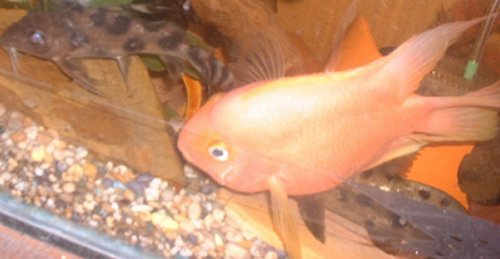
live in a 60x12x10" aquarium in the company of Synodontis decorus,
S.
schoutedeni, S. njassae, large Plecostomus, Raphael catfish, large Botia species
and a group of Red Parrot Cichlids. I would not trust them with smaller fish species. The
pH of their aquarium is 7 and has a high temperature of 79 F. Substrate of fine
gravel. Decor of rounded pebbles, ceramic caves and mopani wood. . Rough territories
are formed. The skin of S. bastiani is not as tough as that of many other Synodontis
so avoid using sharp edged rocks etc. in your aquarium. As long as regular water
changes are made filtration can be minimal. Large sized flake foods, catfish pellets,
prawns and pieces of Thai crabstick are taken with great gusto. Please remember
that the pectoral spines of S. bastiani are extremely sharp so we never use a
net to catch this fish but lower the water level and shepherd into a plastic bowl.
When removed from the water many species of Synodontis make squeaking noises but
have never heard such a sound coming from bastiani. I would not be at all surprised
if this specie would bite as a last defence. Breeding - Occurs during the
West African rainy season when large tracts of grassland become flooded. Scientific
research indicates that distinct pairing takes place. Dark coloured eggs are scattered
in open water and over the substrate. There is no parental care of these eggs.
As the eggs hatch the fry feed upon abundant micro-organisms so that they grow
quickly and put on enough body fat that will enable a high number to survive when
the dry season begins and the waters thus recede back to their normal river courses.
Synodontis bastiani has only found its way into the U.K. aquarium hobby since
the autumn of 2003 so, as yet, there are no aquaria breeding reports
By
David Marshall, Ryedale Aquarist Society Thank You David for allowing
us to use your article.
|